Tell us about the job
Takes about a minute. No obligation.
A contractor quoting a water heater replacement in New Madrid County starts with the service panel, not the tank. Electricity heats more occupied homes in New Madrid County, Missouri than any other fuel, at 54.3% (2020-2024 ACS 5-year). When electric resistance is the dominant fuel across this many occupied homes, the panel is already carrying a heavy baseline load. Adding a high-draw appliance on top of that load means the installer has to confirm the existing service can handle it before anything else gets priced. A panel that runs short trips a breaker on the first cold morning, and the homeowner is back to square one.
Electrical service in much of this county's housing was sized for a world of smaller loads, and a new water heater draws more than what those panels were planned around. Half the homes in New Madrid County, Missouri were built in 1975 or earlier (2020-2024 ACS 5-year). A contractor quoting a water heater swap here checks the service panel before pricing the unit, because an undersized panel turns a straightforward installation into an electrical upgrade job as well. What the panel actually contains decides whether that second job appears on the invoice.
What a Water Heater Installation Covers
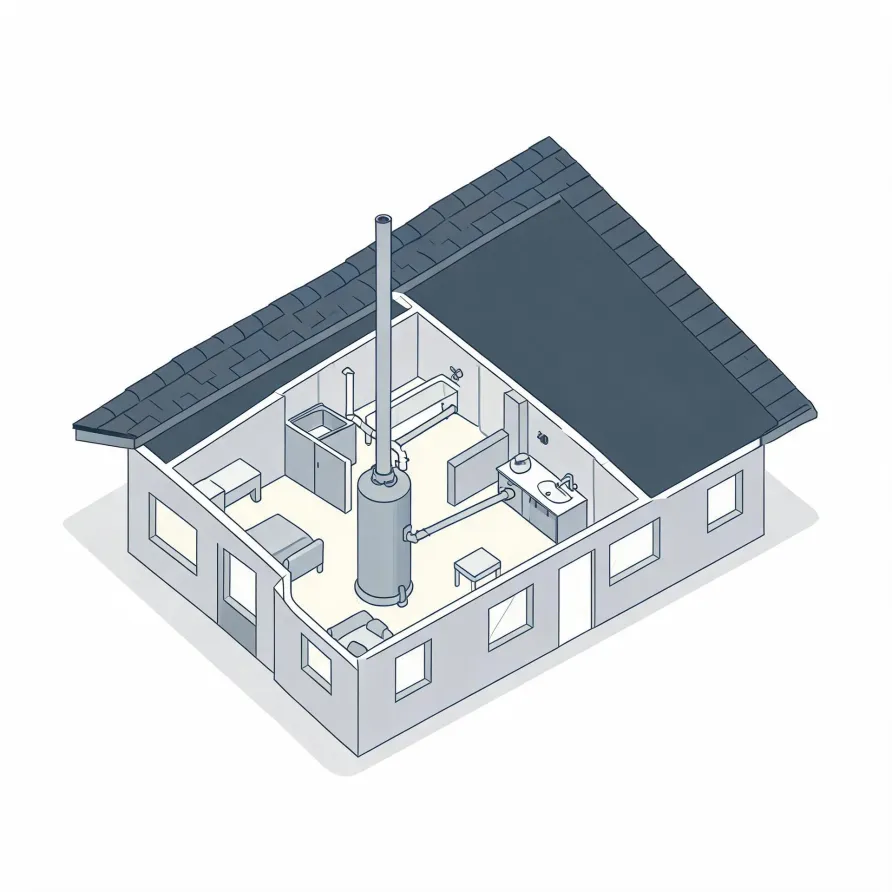
The tank or unit itself sits in a utility space, basement, closet, or garage and is the piece a homeowner sees every day. It holds and heats the water supply for the whole house. The inlet and outlet connections at the top of the unit bring cold water in and send hot water out to every fixture.
The pressure relief valve mounts directly on the unit and opens if pressure inside climbs too high. The drain valve sits near the base and gives a contractor access to flush sediment. A dedicated supply line and the flue or venting pipe, depending on fuel type, complete what a new installation puts in place.
The drawing shows a typical layout, and a licensed contractor determines exactly what the work covers in your home.
Get matched in New Madrid CountyNew Madrid County, by the numbers
105 severe weather events were recorded in New Madrid County, Missouri between 2015 and 2024.
NOAA National Centers for Environmental Information, Storm Events Database, bulk CSV export, events 2015-01-01 through 2024-12-31.Half the homes in New Madrid County, Missouri were built in 1975 or earlier (2020-2024 ACS 5-year).
U.S. Census Bureau, 2020-2024 American Community Survey 5-Year EstimatesNew Madrid County, Missouri holds 7,876 housing units (2020-2024 ACS 5-year).
U.S. Census Bureau, 2020-2024 American Community Survey 5-Year EstimatesOwners occupy 64.2% of the occupied homes in New Madrid County, Missouri (2020-2024 ACS 5-year).
U.S. Census Bureau, 2020-2024 American Community Survey 5-Year EstimatesSevere Weather Events in New Madrid County
Extreme weather puts a hard load on water heating equipment. How often that happens in New Madrid County shapes what a water heater has to handle, and that makes it a factor worth knowing before a contractor sizes or installs a unit here.
105 severe weather events, 2015–2024. Source: NOAA National Centers for Environmental Information, Storm Events Database.